Teeth, Bared
It might not be obvious that the beauty-editor job is dentist-adjacent, but it is

“Smile!” says everyone, to the ladies. “Reflect happiness back at me so I can avoid considering your humanity further!” Or, of course: “Reflect what I might interpret as an eagerness to make out with me so I can feel better about myself.”
There are plenty of unpleasant “Smile!” requests, but it’s also true—as they sometimes point out in yoga—that when you smile, you do feel better. I enjoy smiling, most of the time (though certainly not on command).
But I have this tooth. A tooth I’m certain I brought upon myself: when I was seven or nine or whatever age I might have been, I desperately wanted braces. Plenty of classmates had them. At least a retainer! I bargained to myself.
I schemed, and engaged in my first-ever “long game”: over a period of months, I noted casually to both my mother and the dentist that this one tooth “felt funny”. The scheme bore fruit, and I was referred to the orthodontist. Several weeks later, flushed with triumph and anticipation, I sat in the orthodontist’s chair, eyeing his promising arsenal of machinery. The orthodontist looked at my tooth and listened to my weak claims and—because we had not yet reached peak capitalism—concluded that I did not, in fact, need his services. (If this interaction had happened today, of course, I’d have walked out with the works.)
Somewhere deep inside, however, a die had been set: the tooth grew in sideways, leaving a blank spot—as if I were missing, say, half a tooth—along the top row of teeth.
Over the years, people reassured me that the imperfection was appealing, sexy even. “Look at Lauren Hutton!” they would say. (Not that the tooth resembles a sexy Lauren Hutton/Aimee Lou Wood/Georgia May Jagger-style gap-tooth in any way. The tooth is off to the side, clearly an error—gaping, not a gap.)

“But what about when I’m old?” I remember whining. “At what age does it become a snaggletooth?” It might not be obvious that the beauty-editor job is dentist-adjacent, but it is. So over my career, I took the opportunity to inquire with a number of dentists: might I Invisalign the tooth? Put in a few strategic braces, just to nudge out the spot? My inquiries were invariably met with an explanation that included the words “root canal”. Beauty has to be suffered for, but for me a root canal was a bridge too far.

As I predicted, the sideways tooth haunts me ever-more insistently. It’s all I can see in any picture of myself. It’s all I can feel when I smile—the tooth itself smiling awkwardly, too-eagerly, out at everyone. But a root canal remains as unappealing as ever. And absolutely perfect teeth are no longer the aspiration that they once were: the Love Island chompers (the men were worse offenders in this arena than the women) singlehandedly chased away the ever-larger-and-more-uniform paradigm. Now cosmetic dentists (at least the good ones) know not to bleach so whitely, align so exactingly, or veneer so hugely. And someday, hopefully soon, they will have some half-measures available for the odd-toothed among us.
What I Learned About Teeth
Having been a beauty editor, especially a beauty editor at goop, I know some things about “smiles” (the way teeth are commercially referred to, “teeth” not being the most beautiful word). Why I learned so much about teeth at goop I can’t exactly say. Dentists were hot to be perceived as wellness specialists, I suppose. Some also quite rightly felt aligned with our focus on reducing toxic load; the dental arena turns out to be at least as rife with questionable chemicals and practices as the beauty industry.
Brace yourself, because you’re not going to love much of this information:
Blueberries—those delicious, antioxidant-packed, non-glucose-spiking, fiber-delivering nutrient superbombs that significantly improve rats’ performances on maze tests—stain your teeth just as badly as the obvious red wine and coffee.
Lemon water is also terrible for your teeth, whiteness-wise. The worst is to follow a glass of lemon water with a cup of coffee, as I used to do in the mornings. The acidic lemon rips the protective mantle off your teeth, then the acidic coffee takes a little more off as it pours its deep dark pigment right in for maximal stain absorption.
By the same token, brushing your teeth right before coffee is a superhighway to a stained, prematurely-ancient-looking smile. Brushing your teeth, then drinking lemon water and following it with coffee and blueberries? You might as well start in on methamphetamine.
Many dental flosses contains PFAs, the same toxic “forever chemicals” in nonstick cookwear. The PFAs make the floss glide between your teeth. Really, flossing with forever chemicals? Sadly, absolutely, absurdly: yes. Praise heaven there are now alternatives like Tom’s and Cocofloss.
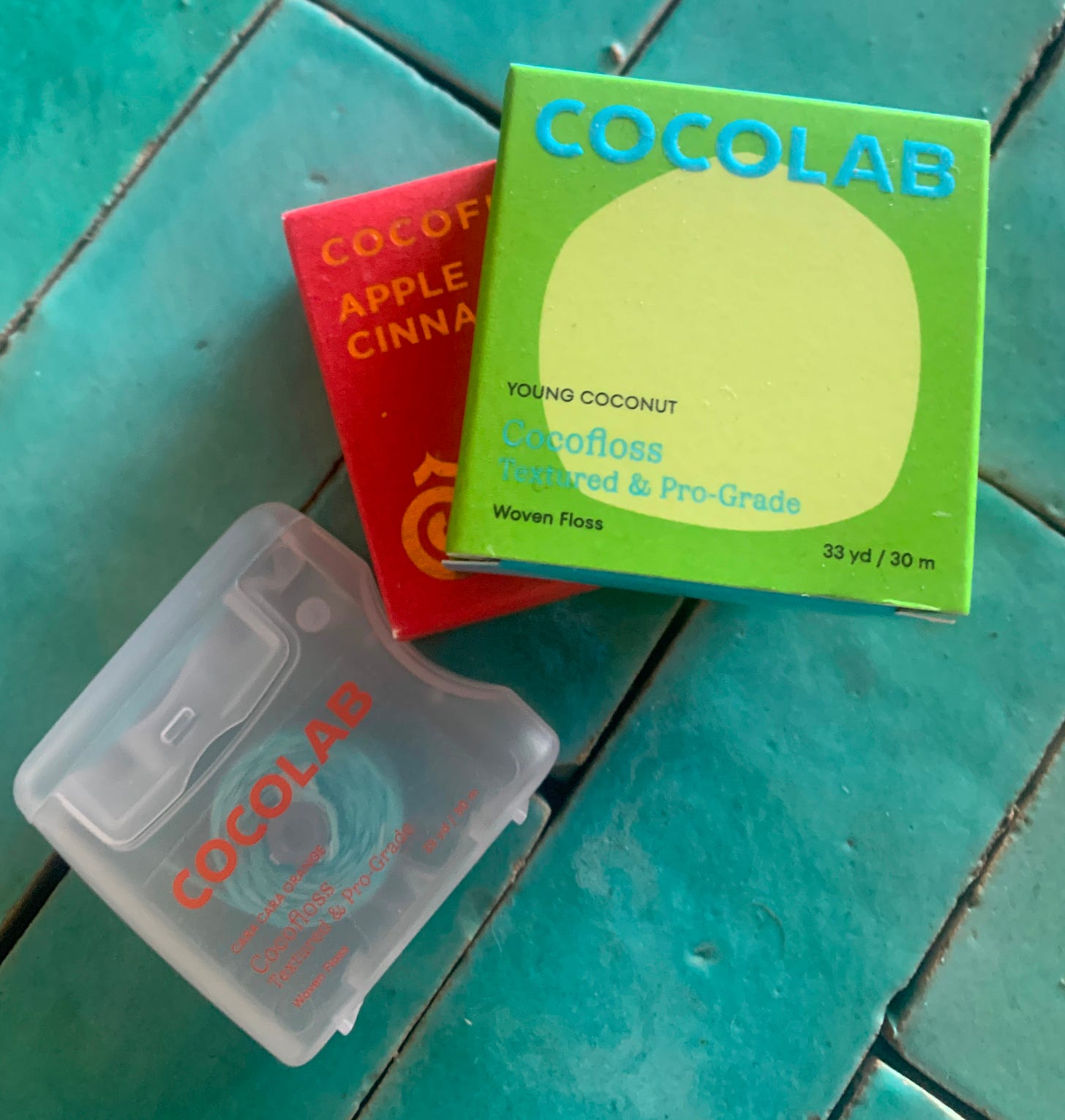
One of my favorite inventions of all time, Cocofloss is a thicker, smoother, much more effective, wildly superior dental floss that will change your life, or at least transform your next appointment at the dentist. It uses coconut oil in place of the forever chemicals. The fact that Cocofloss isn’t made with PFAs is almost tangential to the fact that it works total magic on plaque. It smells delicious—there are many flavors, all of them subtle yet delightful. My very favorite is vanilla. Since discovering Cocofloss early in my goop career, not only do I look forward to flossing (actual truth), but the combination of it + the Sonicare make it so that whenever I go to the dentist, the hygienist exclaims over my near-total lack of plaque. There is no better $10 spent, I’m telling you. Bonus: While giving floss to an acquaintance is ill advised, a box of Cocofloss makes an adorable little (stocking-stuffer-type) present for an intimate—family member, romantic partner, bff. I buy the Cocofloss Everything Set and break it up. If this sounds crazy, try Cocofloss. You too will become and evangelist unable to contain yourself.
Conventional toothpastes often contain SLS, CAPB, propylene glycol, and parabens, all which can irritate your mouth. That irritation can take the form of a fairly common, not-flattering, non-comfortable condition called contact cheilitis, a dermatitis that occurs around the mouth and looks distressingly like a cold sore. The cure is to stop using toothpaste with those ingredients. Again praise heaven for the now-plentiful alternatives. In a rare case of everything going the way you want it to, the non-irritant toothpastes seem to hold themselves to a strikingly higher standard in terms of design. Not only
I love David’s because along with containing none of the irritants, its pale-green aluminum tube both looks fantastic and isn’t plastic, and the toothpaste itself is fresh and effective.
The most beautiful toothpaste tube in terms of pure aesthetics is Dr. Bronners. It looks like Kiehl’s but even chicer, and in a toothpaste. Runner up is the Salt Toothpaste from Weleda, which must have been born in a redwood A-frame somewhere deep in the 70s. (My grandmother always swished her teeth with salt water before bed, a practice that does seem like it could come back around.
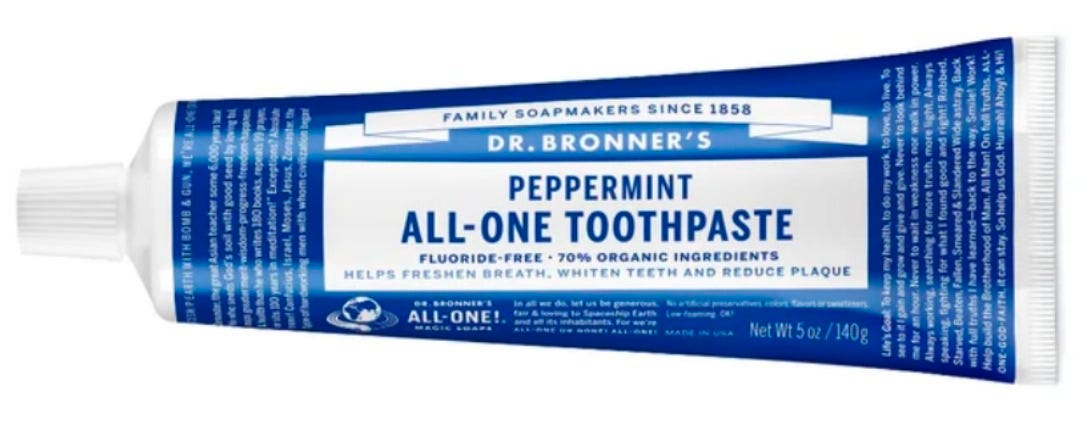
The most “editorial” toothpaste ever. Dr. Bronner’s is as at-home in a spotlessly preserved Richard Neutra masterpiece as it would be in the most ramshackle abandoned palace in World of Interiors.

Controversial Things I Learned About Teeth
You might think to categorize the PFAs thing as controversial, but it isn’t; it’s just true.
The most common surgery in the US is the root canal. Because a root canal involves removing your nerve, it leaves you with no way to sense whether the area in question is infected or not. And it can become infected. It’s not super-common, but some people end up living with hidden infections that their doctors can’t find the source of, sometimes for years. It did happen to me—but was caught within a year, thank god. But the root canal thing is just good to keep in your back pocket if suddenly you or someone you know falls ill and fatigued for no apparent reason. You often have to get a CT scan (not just an x-ray) to detect an infected root canal, so … keep it in your back pocket.
Implants carry the same inability-to-sense-an-infection risk.
God only knows about fluoride. Smart people obviously debate furiously. I personally avoid it in toothpaste.
Both in-office and at-home whitening procedures make your teeth significantly more vulnerable to stains, creating a discouragingly Sisyphean cycle. Extreme whitening procedures can permanently damage your enamel.
Veneers can also cause permanent enamel damage; depending on the type, dentists may have to file your teeth down significantly to get the veneers to sit correctly on your gums.
The unjustly cancelled Dr. Seuss leaves us with this: “Don’t cry because it’s over, smile because it happened.” *this in itself is controversial, as Seuss may have filched it from Ludwig Jacobowski, a poet from the 1890s.
***********
Note: While I only write about products I genuinely love, I can earn commission on products I mention here. If this horrifies you, let me know; I am new to this, and not set in my ways yet.
God and dentists and oral surgeons actually all have a pretty good idea about fluoride
I was with you all the way until “God only knows about fluoride.” 😬
I very nearly had a root canal done and the cold test they gave me to determine if it was needed was SO painful I almost screamed.